Tuesday, February 22, 2011

Prepared to be Dazzled . . . or at least Razzled

From Wikipedia
I started to read "Freakonomics: A Rogue Economist Explores the Hidden Side of Everything."  I was intrigued to say the least.  I have always wanted to understand economics better, and have even attempted self study.  I feel like I am supposed to understand it with both a law and business degree.  But I really just don't.  So I thought, "Ooh, here's a book that is catchy, in a narrative, and maybe I'll pick up some economics . . . better yet, some Freakonomics . . ."

So I began to read.  I read a book in an artful way, like the way Mortimer Alder guides us in "How to Read a Book" (by the way, if you haven't read this book, you're fooling yourself if you think you know how to read a book, and if you think you know how to read a book, this book will in fact correct your deficiency in book reading . . .).  I start at the cover.  I read the inside flaps, I read the back, I read the table of contents, the reviews, the explanatory note, the preface, the disclaimers, the theses, etc.  I haven't even gotten to the first page of content but the expectation for Freakonomics is palpable!  The authors have already told the reader their credentials, their claims to fame, the artistic intelligence.  I turn, with excitement, to the introduction, titled, "The Hidden Side to Everything."

I began to absorb their narrative.  They begin to explain that crime dropped drastically in recent years, in large, dangerous cities.  They begin to unfold the story of mayors, police chiefs, councilmen, politicians, and other civic leaders that take the glory for keeping the streets clean and safe.  Then they uncloak the mystery of the real reason for the drop in crime . . .

Roe v. Wade legalized abortion in the early 1970s.  1972 to be exact.  Twenty years before the massive drop in crime.  The two authors theorize that the freedom to abort an unborn baby brought a drastic drop in crime because these unborn babies in particular would grow up to become criminals.  Their mothers were
"poor, unmarried, and teenage."  Sounds to me like abortion solved a national crisis...

from Zazzle.com
Except for the fact that abortion may not have solved the crime problem.  Correlation does NOT imply causation.  Picture this: You're driving down a rural highway and you begin to see more telephone poles.  You begin to see more at increasing intervals.  Then you realize that you begin to see more cows.  And you begin to see more cows at increasing intervals.  Would it be wise to say, "The increase of cows is the cause of the increase in telephone poles"?  No, you would say, "That's probably a coincidence."

Can we know that the only women needing abortions in the 1970s were "poor, unmarried, [ ] teenage[rs]"? Of course not.  Can we know that the drastic reduction in 1990 crime rates was because criminals were not born? Of course not (for after all, many law abiding citizens were also not born).  My zeal to learn anything from Freakonomics has been quelled.  The authors are probably brilliant.  But to lead with a feigning right hook leaves me cold.

Friday, February 11, 2011

I Want the World on a String

Image from
abajournal.com
The February 2011 issue of ABA Journal contains an Article titled, "Law School? Bag It, Bloggers Say." Recent law school graduates and current third year law students are 'scamblogging' their job frustrations . . . Or let me say it more accurately: their 'lack of job' frustrations.

This article includes several examples of outraged law graduates and current law students. Their outrage is geared and pointed at their law schools.  Their outrage is directed from the current job market.  Their outrage is outrageous.  Why you ask? I'm glad you did.

ABA Journal reports, "[O]ne Boston College Law School 3L recently wrote an open letter to the school's dean asking for a return of his tuition in exchange for a promise to drop out of school without obtaining his degree. 'With fatherhood impending, I go to bed every night terrified of the thought of trying to provide for my child and paying of my JD, and resentful at the thought that I was convinced to go to law school by empty promises of a fulfilling and remunerative career" (emphasis in the original)

Really?  What a ridiculous statement. In the law of contracts, even if you get a bum deal, with consideration, bargain, and a "meeting of the minds" you still get a contract.  So, if this 3L listened in Contracts, he'd know that he will be responsible for making the decision; for making the contract.  Also, does he think his three years of money was for paper?  That he has WASTED his money? He has after all gained three years of legal knowledge.  He, as Kingsfield said, has had his brain turned from mush and now thinks like a lawyer.

Image from
concurringopinions.com
And what empty promises?  The promise was to receive a law degree from that school, which he will. No school ever promises that you'll change the world making $200,000 per year.  Do law schools really need a "These results not typical" disclaimer when promoting their alumni?  Also, assuming he'll pass the bar, he will be in a select profession.  One that is fulfilling and remunerative (unless you're pro-bono).

Mark Twain aptly said, "Don't go around saying the world owes you a living, The world owes you nothing. It was here first."  Really, if you're an attorney, you're never unemployed.  There is always a market for honest, compassionate attorneys that call their clients back and care about the person.  Make a reputation for yourself and the money will make itself.

Friday, January 21, 2011

Leadership and the Self-Deceived

Image found at
LeadershipNow.com
The Arbinger Institute put out Leadership and the Self-Deception.  The book keyed on how humans keep themselves from true success by putting themselves in a box.  We justify why we don't do the right thing at the instant we have that opportunity (that is a pretty surface review, and if you have an interest in serving others and leading others, you SHOULD read the book).

In our social media driven culture, it seems that everyone wants to be a leader, everyone wants to be a life-coach, everyone wants to be somebody and have otherbodys follow them.  My friend posted on his blog that his 2011 New Year's Resolution will be a strict "Not Read Any Non-Fiction Books."  Read that post. If you don't, I'll tell you that he basically states, pretty accurately, that everyone is trying to find the road to success through the experiences of authors telling their readers which 1-2-3 steps to take.  Now I on the other hand, I will probably read only non-fiction books, but I do understand his point and sympathize with it.

And here's why: I see manybodys, who could be anybodys, become quote machines on the internet.  "Do something great, at some place, to someone, and its profound." -Ancient Chinese, Biblical Proverb from the middle of the 20th Century.  It seems that these quote producers (not the speaker, but the quoter) are quoting these things for the sake of their wanted followers.  They expect Facebook, or Twitter, to take them to the top of the Leadership world! That in twelve-short months, following these three-easy steps, they will be internationally renowned leadership gurus.

Image from
JohnMaxwellonleadership.com
John Maxwell, an ACTUAL leadership guru makes this statement about leaders in Developing the Leader Within You: "If they could not lead themselves, they could not lead others."  He often states something to the effect of "Good leaders lead themselves first."  He explains that true leaders focus on their own growth and discipline, and then on ADDING VALUE to others.  This is the kicker for many wanna-be leaders.  They want to be leaders so they can turn around and see a roaring, seething mass of people cheering their greatness.

Now I do not attest to being a leader.  When I turn around the only person behind me is my wife.  And in all actuality, she's beside me.  (The one person I hope to keep behind me is the devil.)  However, I do want to increase my potential by examining my shortcomings and strengthening my weaknesses.

I honestly believe that if all of our friends and acquaintances, that would like to be more than self proclaimed leaders, sought to increase the value in others through their own personal growth, our society would be benefited.  If the selfishness of desired leadership were exchanged with the selflessness of true leadership, we would have a positive influx of circulatory facilitation, increasing our society's worth.

But I guess that's why not everyone's a leader.

Sunday, January 9, 2011

The Hunting of the Snark

Image from en.Wikipedia.org
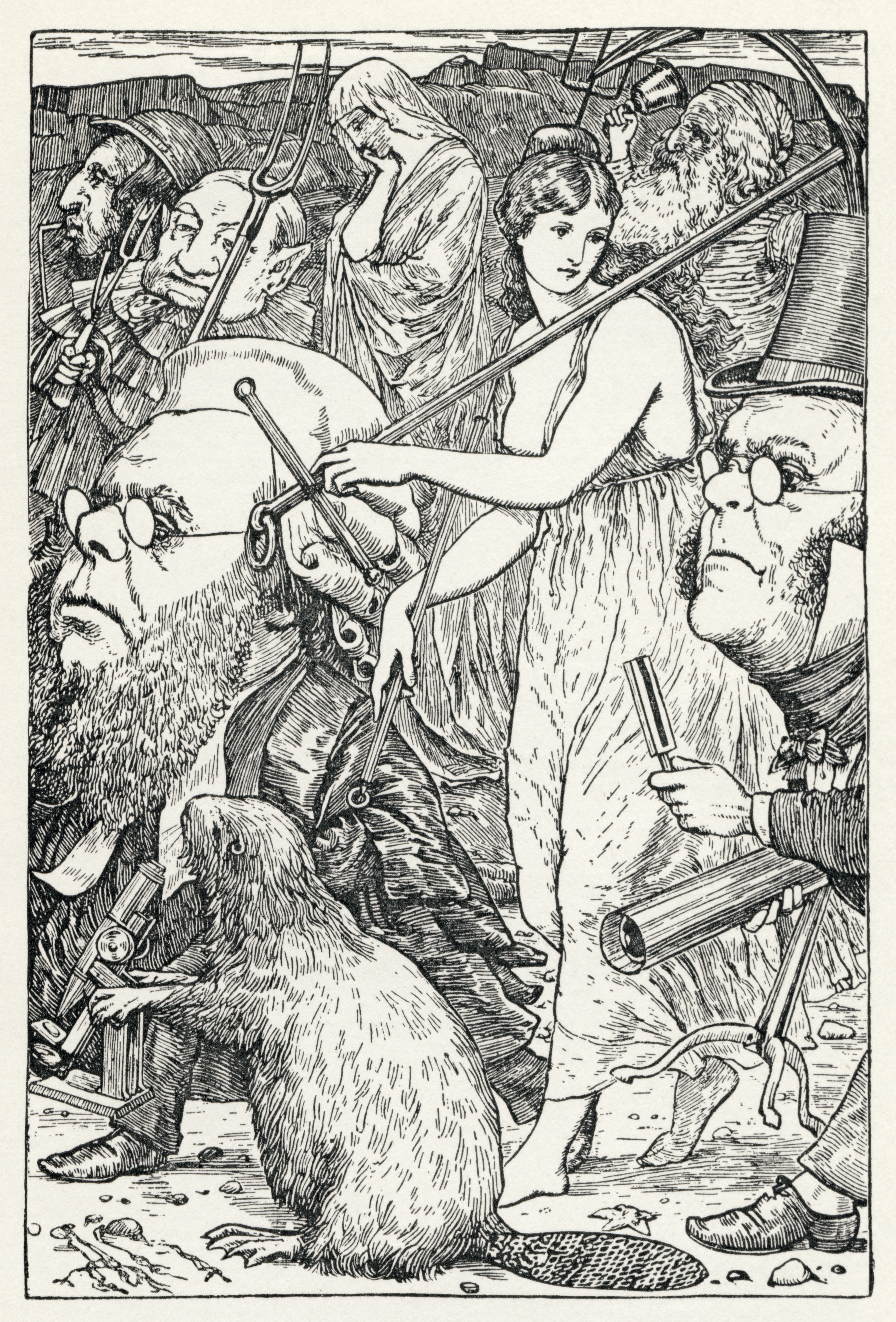
"They sought it with thimbles, they sought it with Care;
        They pursued it with forks and Hope;
They threatened its life with a railway-share;
        They charmed it with smiles and soap."
                     ~ Lewis Carroll from The Hunting of the Snark


The Snark . . . An inconceivable creature to be caught by an improbable crew on an impossible voyage to do so . . .

On Friday I was sitting in Federal Court watching the impossible voyage of an improbable crew catch an inconceivable creature.  I was watching a Federal deportation case, in which a young Guatemalan man's freedom hung by a three-corded rope: the United States justice system.

So I sat, as the translator explained the words of the Judge, the US Attorney explained the sentencing, and the Federal defender explained the man's plight.  The young man pleaded guilty to violating Title VIII of the United States Code.  He will be sentenced to two years in Federal prison if he is found in violation again.

Our Federal Courts are attempting to catch the inconceivable creature of illegal immigration.  The courts have a blank map, the Bellman's contradictory navigational orders, the Baker's language barrier, and the Banker's ludicrous bribes.  These form the improbable crew.

Image from
mow.uscourts.gov
I was trying to calculate the amount of resources the US was pouring into this thirty minute event.  The cost of the judge's pay, the US attorney's pay, the lights, the microphones, the translator, the public defender's pay, the US Marshall's pay, the paper work, the clerk, etc.

I was trying to empathize with the young man.  A foreign land (of opportunity), incarceration in another nation, an unfamiliar language, the thought of home, the possibility of a reliant family, the nearness of freedom, etc.

What's more important?  No, calculable costs cannot be allocated to a human life.  And a nation driven by taxes cannot spend infinite amounts of money on any person.  But a nation driven by taxes can do a better job of keeping these cases from happening.  It can attempt to keep illegal immigrants from the hardship of incarceration, the fear of unfamiliarity, and the hope of home by ensuring they do not get in this position in the first place.  It can attempt to lessen used resources by keeping payroll judges, US Attorneys, US Marshals, and Federal Public Defenders from allocating their time to deportation cases. It can bolster security at gaping borders.

Do I make this argument because I think illegal immigrants should be second-class citizens, subject to hate, disdain, and racism.  Absolutely not.  I make this argument because I think that illegal immigrants should abide by the laws of a nation; which would inextricably protect them from these sentiments held by others.  I make this argument because I think a Nation of Laws should ensure those laws be not broken; which would inextricably protect it from a drainage of resources.  For the protection of human's rights and citizens' taxes, the United States must curtail the entrance of new illegal immigrants.  It must focus its attention to a progressing problem.

It must catch the Snark, which will
     "seem[] almost too good too be true.
Then [will] follow[] a torrent of laughter and cheers;
     Then the ominous words 'It's a Boo-'
Then Silence.

For the Snark was a Boojum, you see."

Monday, December 27, 2010

Calling the Kettle Black

This is not the first of its kind, or the last of its kind. I have read several cases from several jurisdictions that are unfortunately similar.

I come across these cases because I'm in the middle of writing a piece that reviews every United States Court of Appeals' line of decisions that interpret "reasonable accommodation" from Title VII of the Civil Rights Act of 1964. Reasonable Accommodation specifically comes into play when an employer has discriminated against an employee on the basis of race, color, religion, sex, or national origin.


Peterson v. Hewlett-Packard Co., comes from the 9th Circuit. 358 F.3d 599 (9th Cir. 2004). The plaintiff, Richard Peterson, sued Hewlett-Packard for "terminating him on account of his religious views and that HP failed to accommodate his religious beliefs." Id. at 601. Another case of big corporation beating up on the little guy, right? Not so much . . .

The reason that Peterson was fired was because of insubordination. Id. at 602. Hewlett-Packard began a diversity campaign by hanging posters all over the workplace. Id. at 601. One in particular showed an employee above the caption, "Black," "Blonde," "Old," "Gay," or "Hispanic." Id.

Now, Mr. Peterson describes himself as a "devout Christian," Id. As a devout Christian, Mr. Peterson sought to expose evil when confronted. Id. He saw these posters as confronting his Biblical beliefs; the one that read "Gay" in particular. Subsequently, he posted scriptures over the posters. One reading from II Corinthians, one from Isaiah, and one from the dreaded Leviticus passage . . . dun dun dun . . . ! Of course, these scriptures all relate to homosexuality being a sin and therefore warrantying condemnation (scripturally, God's condemnation at judgment, not Mr. Peterson's interpretation of man's condemnation from 9-5).

According to Mr. Peterson's own testimony, these posters were "intended to be hurtful." Id. at 602. When Hewlett-Packard attempted to allowe Mr. Peterson to remove the posters he declined and HP gave him the ol' boot to the streets. And then Mr. Peterson sued based on religious discrimination . . . And that's the Pot calling the Kettle black . . . or at least gay.

I wonder what Jesus would say about such things . . . Well I'm glad you asked, because I'm sure he did say something about how to treat other people. I think at one point, he may have said, "Love one another. As I have loved you, so you must love one another. By this all men will know that you are my disciples, if you love one another." John 13:34-35. He also said, "Blessed are the merciful, for they will be shown mercy." Matthew 5:6. He instructed, "Love your enemies . . ." Matthew 5:43.

Paul, the most prolific New Testament writer stated, "Love does no harm to its neighbor. Therefore love is the fulfillment of the law." Romans 13:10. So now I can ask, without being judgmental, "What was this Peterson clown thinking?" I know it's easy to get caught in the moment and act VERY un-Christian. But, making a stand against a person in the name of Christ because they are "sinners" is like an illiterate in a library. It's not productive.

All groups can, and should, make stands against ideologies that they don't believe in. Debate is one of the great things in which Truth is found. However, people should not use discrimination, hate, or slurs to propagate their positions. After all, the balance between loving people and hating people really is an easy one to strike. LOVE PEOPLE! That is, if you're a devout Christian. And do celebrate diversity, it could be another opportunity to "fulfill the law."

Wednesday, December 15, 2010

Social Injustice

Innocent until proven guilty. And if proven guilty, not punished as if you were innocent. At least if you are a Hollywood celebrity.

Why is there such a divergence between justice for celebrities and the rest of us? And then further divergence for black male athletes . . .

A few examples:
1) Lindsay Lohan has been in court for violating probation, drug charges, and a DUI. She was actually sentenced to ninety days in prison followed by a three month rehabilitation program. She did actually go to jail . . . for FOURTEEN DAYS! Then she went to her three month rehab program . . . for TWENTY-THREE days! And now she is back on the scene (at least she was at the Dream Center in LA the other day, according to her Twitter page).

2) Paris Hilton was arrested for cocaine possession. She was arrested although she said it wasn't hers, she didn't know it was there, and that it was gum. She plead guilty to cocaine possession, obstructing an officer, and paid her $2,000 fine. She is supposed to complete 200 hours of community service and is on a one year suspended sentence. However, the fine is less than the purse she carries. So really, if the average woman gets arrested for cocaine possession, they should be fined around $100 and go on their way . . .

3) Charlie Sheen has been in the news several times for domestic abuse, drug abuse, and other things. His latest debacle includes admitting to cocaine use while causing $7,000 worth of damage to a hotel room. Oh, and the police found a woman locked in the hotel bathroom. His punishment? Taken to a hospital for observation and released. The case was dropped by NYPD.

(I won't take the space to discuss the Ben Rothlisberger stunt but the justice system turned its blind eye while the Steelers are exacting punishment . . .)

What do these instances tell us? I don't know, what do you think this tells American society? Does it tell us to get rich and famous to circumvent the law? Does it tell us idolize these people further for their ability to rise above the law? Does it tell us that the rest of us are bad enough for punishment and escape the mercy of forgiveness?

Take a look at the link provided: It is a list of mostly black athletes that have been convicted and serve jail sentences. The charges include assault and trying to use a cell phone to set up a drug deal. (Another question for another day is, "Are black athletes punished more harshly because the crimes are more violent?)


I think the our justice system fails everyone in American when the divergence between social, financial, and racial classes is marked and obvious. It is a sad commentary on the obsessions of America

Friday, December 10, 2010

The Future of Disbelief

I wonder why it seems that our culture is slower to believe. Is it because our lack of knowledge and learning, or because we are increasing our knowledge through mediums like the internet and access to formal education. You be the judge.

This statement was made during a recent exchange between friends on a social network, "There was NO Jesus, unless you believe in fairy tales that is." This could be a simple lack of precision, but I do think that it is more than that. It reminded me of this:
When I was in history class in high school, we were discussing the Middle East and its culture, its religions, etc. One student raised his hand and said (and it has been a long time so this isn't a perfect quotation) , "You can't teach me that Jesus lived, and I don't believe that he did." To this the teacher retorted, "Jesus was an historical figure, based on historical fact. But you do not have to believe his claims, that he was God and man, and the Savior of the world."
As an aside: " . . .unless you believe in fairy tales that is," is a very interesting idea tacked on to "There was NO Jesus." I say this because there is SO much nonsense that people believe that has no logical merit in their search for meaning. For instance, Nietzsche's idea of "Nothing matters, and so what if it does" nihilistic approach is almost swallowed whole by those with lofty desires to be seen as academic and mentally forward.

However, I've never thought it  lofty or academic to believe in an illogical assumption for the sake of sounding intelligent. If there is no objective morality, then it cannot matter what anyone does, whether it is Jesus claiming he's a god, or Timothy McVeigh killing 168 innocent people in domestic terrorism, or Hitler gassing six million Jews. If you think ANY one of these events is wrong, then you must concede that you believe in objective morality. Unless you want to believe that you alone set the boundaries of morality. Even in that case you must believe in objective morality and that you decide its objectivity.

So is, "There is NO Jesus . . ." simply an assertion of the desire to believe that Jesus is not our Savior, an assertion of poor education, or an assertion of the nonsense that our culture has been swallowing whole, gizzards included? Like I stated in my last post, I'm a skeptic. But I'm a skeptic for untruths and poor reasoning. I believe truth when, and if, I can ascertain it. And if an idea points to nowhere, and comes from the same, I cannot believe it.