Wednesday, November 16, 2011

4L: What to do when . . . You get your first client

OK boys and girls! This is it! You've finally delved into the practice of law because you now have a client!!!!! Congratulations! Throw a party!  . . . and then become very afraid . . . (which you've probably already done).  But don't fret, because you're worth your rate even if you don't think so.  Well it IS true.  And now we're going to increase your worth.

Now that someone has actually decided to hire you, what should you do?  You need to decide where to meet the client, what to bring to the meeting, and what to say (or better yet, how to act).

Where to meet
That really depends on if you're practicing out of your house, your parents' basement, or an office.  If you're practicing out of your home, you should be aware of some issues that make it hard to meet there.

First, are you willing to allow a person you don't really know come into your home? When I practiced out of my parents' basement, and then out of my downtown apartment, I never was willing to do that.

Second, is your home ADA compliant?  If you're not in a wheelchair, it probably isn't.  In that case you should punt your meetings to another place.

Third, can you maintain a professional atmosphere in the home? And by this I mean DO YOU HAVE A FREAKING OFFICE IN YOUR HOME (my father would not approve of that euphemism, however, he has used it recently [at the age of 77])?  If you are going to meet in your kitchen, bedroom, or even at your dinning room table, you may consider heading to a quiet corner (CONFIDENTIALITY) of a Panera or Starbucks (this recommedation is in no way an endorsement of either business and until I receive advertising checks from either, it will remain that way ;-)). 

Also, if you practice from home, getting out will help you defeat the feelings of isolation and help create an emotional disconnect from your home workspace.  Take every opportunity you can to get out of the house if you practice from home.  The sun will do wonders for an unmotivated day.

When I practiced out of my downtown loft, we had a downstairs conference room and lounge.  I opted for that and it always seemed credible to my clients (I also had a security officer that would have to call me down so it seemed much more big-time than it really was).

I've also offered to meet at the client's home, and they've appreciated this depending on their situation. This can also be dangerous and I would not recommend female attorneys meeting at a male client's home (I'm old fashioned, but "old fashion" trumps "kidnapped and mangled death" . . . I win).

If you work from an office . . . meet at the office.

What to Bring
You need to bring a pad of paper for notes.  You need to bring two pens (if your only one stops working, you'll look unprepared).  You need to bring two fee agreements.  You need to bring a client intake sheet for their personal information.  You need to bring something to bring these in.  You need to bring a mind of research. 

Hopefully you spoke to the new client enough to know what AREA of law this is.  You should do some foundational research on the issue at hand, and some offshoot areas.  And this isn't because you're going to resolve the issue.  It is simply so your clients think you know what you're talking about.  You must instill confidence in them here.

What to Say (How to Act)
Control the situation, but listen.  Your new client will be expecting you to tell them what to tell you.  They'll be expecting you to tell them when to tell you.  They'll be expecting you to tell them what you know.  As this may be your only meeting before you go to court to argue a motion, or before drafting a pleading, get as much information as you can here.  Ask them to tell the story from the top, in excruciating detail.  And take notes.  Not so much that you miss it, but enough that you get the issues for later.  After they tell you, then tell them. 

Tell them the area of law.  Tell them what the courts generally say in these instances.  Tell them the TRUTH.  It they have a case that will lose, you better tell them! You'll be on the hook later anyway!  If they have a losing case, tell them how you're softening the blow, or at least protecting the amount they will lose.  CLIENTS APPRECIATE THIS. THEY DO. NO, SERIOUSLY... THEY DO.

Fee agreement time . . . dun, dun, dun . . . Why is it so hard to ask people for money for services you just don't believe in?  I know it is.  But the client believes in you, so don't let your feelings of inadequacy get in the way.  Say, "Ok, I can do [rattle off what you're going to do in their case] and here's what I charge . . ." (look at the market, but $175.00 - $225.00 per hour won't scare most clients in larger areas.  If you're in a smaller areas $125.00 per hour will do).  You have to be confident here.  Don't offer discounts, or lead on that your rate is too high.  I've done that.  I never got paid . . .

When I say, "You WILL PAY ME OR I'LL THROW THE GAME," I get paid . . . Seriously though, if you're confident in your rate, and ask for the money, you'll get the money.  Don't apologize. 

Get both agreements signed and send one with them.  Have them fill out the intake form while you're closing the deal.  Thank them for their time, tell them you'll be in touch (because you will be sending an engagement letter), and send them on their way.

Congratulations! You have a client.  Now get to work. 

Sincerely,

Your Dear Wormwood


Wednesday, November 9, 2011

Why you suck as an attorney . . . No Seriously

You NEED to read this if you practice law.  If you don't, you may end up sucking.  This is from a client's perspective, so if you're wondering what they think about you, look no further . . .

READ ME! . . . and you won't suck . . . 

And we all know you don't want to do that . . .

With Love,

Lionheart

Sunday, November 6, 2011

4L: What to do when . . .

Law School,  It's prestigious. It's honorable.  It's professional.  It's tough, it's exhausting, and it makes you think like a lawyer.  It also gives you just enough tools to go out and get yourself into trouble.

 If you have recently passed the bar, you are now equipped to take your clients to court.  You are equipped to receive payment for the services you render.  You are now equipped to practice law.

The problem with practice, in any endeavor, is if you practice incorrectly, you begin to develop habits that keep your growth to a minimum.  And the problem with law practice is that you DON'T EVEN KNOW HOW TO START!

One thing law school does not do is help you successfully engage in the practice of law.  With the amount of law graduates that begin a solo practice right out of law school, or join up with other recent grads to make a small firm, there should be something out there that tells these armed-and-dangerous attorneys where to aim their weaponry and how to discharge it appropriately.

I'm not a genius, or a law practice guru.  But I am a young attorney that has learned some fundamental practice tips over the last year of practicing by myself.  I've learned with the help of experienced mentors and the school of hard knocks.  Thus, I will begin to periodically publish a series of practice lessons for the recent law-school-graduate-solo-attorney -- or more aptly called: the 4L.

Some of them will be:
- What to do When . . .You Don't Have Clients Part 1 . . . Relationships
- What to do When . . . You Don't Have Clients Part 2 . . . Learning the Law

- What to do when you meet your first client
- What to do when you get your first responsive pleading
- What to do when you write your first complaint
- What to do when you argue your first motion
- What to do when go to court for the first time
- What to do when when you need to file your first federal pleading using the ECF electronic filing system
- What to do when meet other attorneys to develop a referral base
- What to do when you rent your first office space
 - What to do when you get removed to federal court for the first time

I will also be answering specific questions that 4Ls (and anyone else) need answerin'.  If you have a situation that needs practice tips, please email me and I will make your question the next blog in the series.  And I don't mean questions that require you to do a little research!  Do your own independent research (and DO use Google) to get a foundational answer.  You will be better off when you actually ask.  Just remember, it is not like grade school, there are dumb questions . . . :-)

www.lawmcd.com


Here's to a safe and happy malpractice-free practice!


Thursday, November 3, 2011

Stumbling Blocks or Stepping Stones

Adversity.  Opposition.  Setback.  Why do these words bring us emotional discomfort?  Some of you are already thinking about specific circumstances you're going through right now.  And you're tensing up and getting anxious.

And that is completely understandable.  I face opposition on a daily basis in my law practice.  And typically I take the worry home with me.  Why?  Because I think I will lose the case.  Or I think I will lose my clients' confidence.  Or I think I'll look stupid in front of nine appellate judges.  And those worries are pretty minor to your cancer, or dying son, or you property foreclosure.

Now think about what life would be like without your adversity . . . Without your cancer . . . Without someone trying to harm you . . . Without your accuser telling lies . . . It may seem nice for a moment, but I don't think we would do very well without it.

Adversity is a motivator.  It forces you to move.  It is a teacher.  It forces you to make decisions.  It forces you to stand up for what really matters to you.  It forces you to evaluate what does really matter to you.  Adversity makes you strong . . . If you let it.

How do we let suffering produce perseverance in us?  How do we let perseverance produce character in us?  We have to turn our stumbling blocks into stepping stones.

I had a situation that has been the single most stressful event in my life.  And then add trying to complete a law degree and a MBA while this is happening.  And at this point, I had just started a relationship with my then future wife.  I remember certain days that I was nearly nauseous with feelings of despondency.  I literally did not know what to do with my adversity on a regular basis.  At that time I thought everyone was against me.  I thought my career would be hindered.  I thought my dreams were collapsing in front of me.

Looking back, I can see that the ENTIRE situation was beneficial to me (well and to my wife).  Because I was faced with some unbelievable opposition on a daily basis, I was forced to take steps to rebuff it.  I was forced to encounter people to plead my cause.  I was forced to learn how to write assertively but kindly.  I was also forced to understand what many of my clients go through daily.  Fear and unfounded accusing.

One of the MOST important lessons from that time was that I developed life altering relationships with some of my favorite people.  I became closer to people that have been a blessing to me time and time again.

Not everyone was against me.  My career hasn't been hindered.  In fact it has been fantastically benefited.  My dreams were not crushed.

Although you may feel like I did, it is not true.  You are facing this for a purpose.  You are facing this adversity to be shown with high character.  You are facing opposition to be an example for others when they face their adversity.  

When you're faced with constant adversity, utilize that time to find out who you are, what you're good at, and where you're going.  With each act you take, see it as an opportunity to learn something new.  See it as an opportunity to build new relationships.  Turn your suffering into perseverance, and your perseverance into character.  Turn your stumbling blocks into stepping stones.

Tuesday, September 20, 2011

Let's Get Meta-Physical


I'd like to hear Olivia Newton John sing that . . .

Meta-physics - the branch of philosophy that treats of first principles, includes ontology and cosmology, and is intimately connected with epistemology. Also, a treatise (4th century b.c.) by Aristotle, dealing with first principles, the relation of universals to particulars, and the teleological doctrine of causation.

Ontology - the branch of metaphysics that studies the nature of existence or being as such.

Cosmology - the art or profession of applying cosmetics. . . . Wait that's cosmetology . . . Cosmology is "the branch of philosophy dealing with the origin and general structure of the universe, with its parts, elements, and laws,and especially with such of its characteristics as space, time, causality, and freedom."

Epistemology - a branch of philosophy that investigates the origin, nature, methods, and limits of human knowledge.

Teleology - the doctrine that final causes exist.

Now that we got THAT outta the way . . .

So here's the deal. I hear all kinds arguments against the existence of God. I hear about how religious adherents are not intelligent (really, it's only Christians. I've yet to hear a person admonish an Islamist or an Atheist for using emotion instead of logic) . Nor are they tolerant. In fact, Christians in particular are intolerantly and disgustingly exclusive. These arguments are chock-full of metaphyiscal reasons why the atheist, or the evolutionist, or the existentialist is absolutely correct and Christians are wrong.


Two observations:

Observation 1) Anyone who condemns the Christian for being exclusive while arguing an exclusive position negates their own argument. Even if they argue that everyone is correct in their arguments except those adhering to exclusivity. Now they are excluding the one thought and thus condemning their own argument. Furthermore, many times, the argument gives "evidence" that does not exist. This cartoon showing a baseball is never the case in these debates. Many times, the argument that Christianity does not have evidence for reason is "proven" without evidence (merely the supposition) that God does not exist, or that evolution happened.

For instance, the "there is no God" argument because of world suffering is intrinsically riddled with fallacies. If you argue that no just God would allow such things, you must assert the following: A) There is moral good and bad (because you are now telling me that suffering is bad and not suffering is good), and B) that moral good has been established by something (if there is a good or bad, which you assert, it comes from somewhere, if not from yourself as judging what is good and bad). So if morality is there and you are judging morality, then there must be a standard of morality. Now you must determine the source of morality. If you argue that we each have our own standard, then your argument falls on its face. If my moral standard is lower than yours, I can say that God would allow such things to happen. You say that your standard would not allow it, arguing for exclusivity of your standard of morality. Back to square one.

Logically, there is a better chance that all religions and ideologies are wrong and then there is of all being right.

However, giving the ontological reason for suffering (i.e., sin and fall of man) ceases the circular arguendo.

Observation 2) Between existentialism and Christianity, Christianity is the only logical belief system. Blaise Pascal, the SCIENTIST and mathematician put it this way: We cannot be certain of the existence of God or the non-existence of God. If you believe God does not exist and are wrong, you have everything to lose. But if you believe in God and are wrong, you still fulfill a existentialist's perfect reality. If you believe in God and are right, you are in paradise.

The best part about this blog post: it will not have any effect on those that adhere to the idea that Christians are stupid or exclusive. And in that, I prove my point.

Monday, September 12, 2011

Makin' a Comeback

Hey Friends!

It has been too long since I've been blogging.  I don't say "writing" because I've been writing everyday . . . just not the type that has general interest to most of the world wide web.  For instance, I have a brief due to the Missouri Court of Appeals on Monday, which means I'll have to send the original and nine copies today, or rush them off tomorrow.

However, I still have to tweak my last argument and put together the appendix (not my favorite part).

Some blogging topics that will be coming down that pike include to transform negative situations into growth opportunities, how meta-physics affect us all, and the some legal considerations businesses may have and not know it.

Stay tuned!


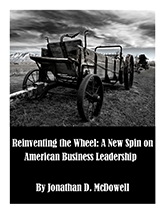
Reinventing the Wheel

New article of the Regent Global Business Review.

http://www.regent.edu/acad/global/publications/rgbr/home.shtml

I authored the first article title, "Reinventing the Wheel: A New Spin on American Business Leadership."