Monday, September 12, 2011

Makin' a Comeback

Hey Friends!

It has been too long since I've been blogging.  I don't say "writing" because I've been writing everyday . . . just not the type that has general interest to most of the world wide web.  For instance, I have a brief due to the Missouri Court of Appeals on Monday, which means I'll have to send the original and nine copies today, or rush them off tomorrow.

However, I still have to tweak my last argument and put together the appendix (not my favorite part).

Some blogging topics that will be coming down that pike include to transform negative situations into growth opportunities, how meta-physics affect us all, and the some legal considerations businesses may have and not know it.

Stay tuned!


Reinventing the Wheel

New article of the Regent Global Business Review.

http://www.regent.edu/acad/global/publications/rgbr/home.shtml

I authored the first article title, "Reinventing the Wheel: A New Spin on American Business Leadership."

Thursday, June 23, 2011

Divining Your David: How to Tap into Your Inner Underdog. pt. 4 of 4 - Purpose


OK! So here we are at the final part. This weapon is the most POWERFUL of the underdog's arsenal. This last aspect of the underdog pulls, Pt. 1 - PreparationPt. 2 - Perseverance, and Pt. 3 - Grit together for the final conflict.


Purpose - No underdog can prevail without purpose. Think about it. Luke Skywalker's purpose was to turn Darth Vader from the dark side of the force. Rocky was avenging Apollo Creed. Nacho Libre reigned victorious for Encarnación and the orphans.

Whether it's for good over evil, friendship, or love, you must have a purpose OUTSIDE of yourself.  Why is this so important? Lets see what our three traits literally mean.

Preparation - any proceeding, experience, or the like considered as a mode of preparing for the future.
There must be a point in the future that preparation is moving towards.  Without purpose, preparation will be unfocused, inefficient, and undisciplined.


Perseverance - steady persistence in a course of action, a purpose, a state, etc., especially in spite of difficulties, obstacles, or discouragement.
Perseverance is persistence towards a purpose! Without an ultimate purpose one cannot persevere as with an ultimate purpose.


Grit - firmness of character; indomitable spirit.
How does a person begin to embody a firmness of character? By having a reason to do so. Think about the things that do not matter to you. Will you be firm in your decisions or actions? Think about the things that matter a great deal. You will have a firmness in character, or grit, in those things.


What is purpose? 
"The reason for which something exists." I like to think of a person's purpose as "calling." A calling is a summons from someone or something. What is your calling? Why do you exist? Stop for 5 seconds and ponder this . . .


What was David's purpose?
In I Sam. 17:46 David tells Goliath why he's fighting him. David challenges Goliath with this: "This day will the LORD deliver thee into mine hand; and I will smite thee . . . that all the earth may know that there is a God in Israel." David's actions all point to this calling. He has been preparing for a future event and is now fearless in the face of intimidation and adversity. He doesn't let a lack of resources deter him, and no one can stand in his way. He is resolute in his actions to prove to all that "there is a God in Israel."

What's an underdog story without an ending? Remember when David promised he would take Goliath's head with a sling?

"As the Philistine moved closer to attack him, David ran quickly toward the battle line to meet him. Reaching into his bag and taking out a stone, he slung it and struck the Philistine on the forehead. The stone sank into his forehead, and he fell facedown on the ground. So David triumphed over the Philistine with a sling and a stone; without a sword in his hand he struck down the Philistine and killed him. David ran and stood over him. He took hold of the Philistine's sword and drew it from the scabbard. After he killed him, he cut off his head with the sword. When the Philistines saw that their hero was dead, they turned and ran."

Find your purposeprepare for it, persevere to it with grit. Join the underdogs in a dramatic and memorable victory in your life-changing encounter.

Monday, June 20, 2011

Divining Your David: How to Tap into Your Inner Underdog. pt. 3 of 4 - Grit

So far, we've found out the first two characteristics of an underdog.  In Part 1 - Preparation, we determined that underdogs are prepared first, then have an opportunity. They do not necessarily prepare for the opportunity at hand.  In Part 2 - Perseverance, we saw that underdogs maintain a single-course mindset.  Although they may be derailed by events, circumstances, and discouragements, underdogs return to a path that will lead them to their life-changing encounter. This time, we'll see the inner resolve of an underdog and their dogged determination to keep getting back up.

Grit - One of the things that makes underdogs so fascinating is their ability to keep getting back up. At first glace it seems as if these characters have resilience . . . and they probably do. But upon a deeper examination, it can be seen that underdogs have more than resilience. They have grit.

Grit is that intangible, immeasurable inner strength that gives birth to mental toughness. Think of Rocky. In his fight against Drago, he is getting absolutely destroyed. Rocky is much smaller, he's bloodied, he's tired, and he's expected to lose. Somehow, somewhere inside, Rocky continues to find the inner strength to keep standing back up. The only way Rocky will not stand is if he cannot physically stand. But his mind won't listen to his body and he continues to rise . . .

David shows the same mental toughness, but against a different foe: intimidation. We last saw David attempting to wear Saul's armor. He's not used to the armor and probably cannot move around well so he decides not to wear it.  Instead, David goes and equips himself with a weapon that he can use. "[H]e took his staff in his hand, and chose him five smooth stones out of the brook, and put them in a shepherd's bag which he had, even in a scrip; and his sling was in his hand . . ." I Sam. 17:40.

So David is heading into battle with his shepherd's staff, which is basically a thick stick, and a sling-shot with five rocks . . . David heads out to Goliath. A man that stands over 9 feet tall, with 125 pound chain mail, a bronze breastplate, bronze helmet, bronze shin guards, and a spear with a 15 pound spear-head.

Goliath sees this small, ill-equipped youth and lets David know his fate. "Come to me, and I will give thy flesh unto the fowls of the air, and to the beasts of the field." I Sam. 17: 44.  Goliath isn't going to beat David up . . . He isn't going to humiliate him . . . He's going to kill David, and then leave his body for hungry scavengers! At this point I would start thinking about the reasonableness of my situation. But David doesn't! He has grit!

David tells Goliath, "I will smite thee, and take thine head from thee; and I will give the carcases [sic] of the host of the Philistines this day unto the fowls of the air, and to the wild beasts of the earth." David is no only threatening Goliath with death and decapitation, but that Goliath's entire army will be devoured! Does David expect to take off Goliath's head with a stick . . .?! Or slingshot . . .?!

There is an inner strength that all underdogs possess.  It is a unstoppable drive to keep moving into the direction of the enemy. To keep rising from the mat. To keep bearing down into the battle. Why have you not encountered your life-changing battle? Did you stop pursuing your dream for fear of failure? Did you stop defending your position because the company is too big with too many resources?

If you want to win, you cannot quit. You must have "an indomitable spirit." You must have grit.

Stay tuned for the final characteristic tomorrow . . 

Sunday, June 19, 2011

Divining Your David: How to Tap into Your Inner Underdog. pt. 2 of 4 - Perseverance

Last time we examined how underdogs are fully prepared for their lifetime opportunity. You can read it here: Part 1 - Preparation. This time we'll explore the underdog's ability to stay the course to reach that opportunity through . . .

Perseverance - Think about your favorite underdog (either from part 1, or on your own).  I'll use Luke Skywalker.  Luke had many setbacks, failures, discouragements, and fought seemingly insurmountable odds.  However, not once did he question whether he would finish his training and battle Darth Vader again.  Perseverance is not just the ability to keep going when it's tough (we'll examine that in part 3).  Perseverance is the dogged perspective that the path ahead leads to one thing: the life-changing encounter. Luke understood that every step on his path would lead to an encounter with Darth Vader. Everything he did increased his skills and abilities for that one opportunity . . . That one chance . . . That one battle.

Let's look back to our case study of the once and future king, David.

Once David decided he would face Goliath, nothing would sway his mind. He knew that any circumstance that befell him would not deter him from facing the giant.

King Saul let David use his armor for the showdown. David, a shepherd, probably never had put on armor before. As we learned in part 1, he fought a lion and bear, without armor, and was victorious.  When David begins to equip himself for a real battle, against a 9 foot armed man, he feels awkward and cumbersome. I Sam. 17:39.  He even says that he's not used to the armor and will not use it! That could be the beginning of discouragement, or even a valid reason to quit!

This does not deter David though.  Even though he is going to fight a heavily armed man, not having armor of his own does not dissuade him! He still knows he is going to fight Goliath.

If we are going to fight and win our unlikely battles, we must know that we are going to fight them. We cannot have a contingency plan and we cannot let limited resources hinder us. We cannot allow any circumstance, failure, or setback to blur our vision for our ultimate battle.

We must have Perseverance: "a steady persistence in a course of action."

Saturday, June 18, 2011

Divining Your David: How to Tap into Your Inner Underdog. pt. 1 of 4 - Preparation

David vs. Goliath. Luke Skywalker vs. Darth Vader. Rocky vs. The Russian. Nacho Libre vs. Ramses. What does the first party in each contest have in common? Each of them are winners. And we love winners.

But each of them was also an underdog. And we love the underdog. We love rooting for someone that has their back up against the wall with nowhere to turn. We love seeing a more apt, more powerful foe succumb to the perseverance, grit, and determination of an unlikely hero. When we read, hear, or see stories of underdogs winning, it makes us feel like we can conquer the world!

So what makes an underdog an underdog, and how do we tap into our own inner underdog? We'll find out through the story of David and Goliath, which can be found in the Bible in I Samuel 16-17.

Before we get to the traits of a winning underdog, lets look at one underdog and his competition.  David was the youngest of eight brothers. He was a "youth" of small stature (some scholars think about 5 feet tall) and ruddy (meaning "red," probably from being in the sun all day). I Sam. 16:7, 10; 17:33. Goliath was a "champion" that stood about 9 feet tall, wearing an armor plate that weighed about 125 pounds, and armed with 15 pound spear. I Sam. 17:4-7. Saul tells David that Goliath was a man of war since his youth. I Sam. 17:33.

I think that if you examine most underdog winners, you'll find that each has four specific traits. We can deliberately embody these traits and win our unlikely battles.


Preparation - Yes, preparation. Even though the underdog seems to have less resources, less experience, and even less confidence, the winners on our list were ALWAYS prepared. The kid in our case study, David, was only a shepherd confronting a huge man.  However, listen to his response when Saul tells him he can't defeat Goliath: "Thy servant kept his father's sheep, and there came a lion, and a bear, and took a lamb out of the flock: And I went out after him, and smote him, and delivered [the lamb] out of his mouth: and when he arose against me, I caught him by his beard and smote him, and I slew him. Thy servant slew both the lion and the bear . . ." I Sam. 17:34-36.

David had been prepared for fighting Goliath by killing much fiercer combatants. He didn't blindly challenge him without skill or practice. And he didn't sit around waiting for an opportunity to then prepare for.  He was already prepared to take the opportunity when it presented itself.

We also need to prepare for the opportunity.  We need to prepare now! When the challenge presents itself, we will be ready to win, through diligent planning and preparing. What do you need to do? Study an area of law? Get to the gym in your off-season and increase muscular endurance? Finish your degree? Rise up to your future challenge by preparing now.

Stay tuned for the next trait . . . 

www.lawmcd.com

Monday, May 16, 2011

Inflate the Facts: The Rest is Just History

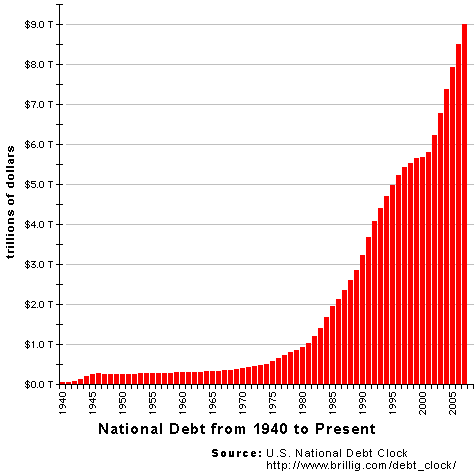
"The national debt under Obama is the highest the United State has ever had!"

"The jury has given a $380 million verdict. The highest in history!"

"The New York Public school janitor has the highest salary in school janitor history!"

Which of these statements is grossly disproportionate to harm? Ok, ok loaded question, I know. . . How 'bout this? Which of these statements can blame be placed on  few people . . .? Maybe even one person? I know, loaded again . . .

I bet I know your answer depending what hockey position you play (left wing, right wing, or center [if you don't play hockey I'll base it on which news show you watch]).  Most right-wingers (or Fox News adherents) will say statement one shows sole culpability. Most left-wingers (or MSNBC devotees) would say statement two is grossly disproportionate (unless the verdict is against a mean ol' corporation). Before you let me box you into a stereotype that you publicly resent (and privately fit), think about these two factors that affect all three statements: 1) inflation and 2) inflation.

1) Inflation: My first class in undergraduate school was "Statistics for Political Science." I was seventeen and remember little.  Two of the few things I remember are the "f" of "x" portrayed as f(x) and statistical inflation (I don't remember what f(x) actually represents but the pronunciation "eff-of-ecks" is solidified forever). Statistical inflation can be achieved easily on a bar-graph.

If I have two statistics on a x/y axis I can make one of those seem visually greater by magnifying the graph.

For instance, I ate 7 cookies and you only ate 5 cookies.  If I display this on a graph with the upper limits of the y-axis at 15, distributed in 1 number increments, the difference between my 7 and your 5 will look very small.

If I change the upper limit to 8 with a distribution of 0.25 your 5 cookies will now look 12 points lower than my 7, instead of the original 2 points with lower magnification. These graphs next to each other will show my 7 cookies much "farther" away from your 5 cookies on the magnified graph with an upper limit of 8. (This can also be amplified by starting at a high ordinal. Instead of the x-axis beginning on 0, start on 4 and see how "low" your 5 looks. Keep this in mind for later).

2) Inflation: Financial inflation rates impact nearly every aspect of our lives. It helps determine our minimum wage, the price of our cars, the price of our homes, and amount of our jury verdicts. In 1980 the inflation rate was over 13%. 1981 gave us a rate over 10%. Between 1988 and 1999 the rates bounced from over 5% down to 2%. The inflation rate coupled with the power of your country's currency will dictate how much your milk costs compared to 1965 (this is a gross oversimplification of the Consumer Price Index but it should depict the idea).

We all know that  a bag of groceries cost more today than it did in 1965 and we don't think twice about it. Newspapers don't exclaim, "Milk costs 3.65 a gallon! This is the most it has EVER cost!" Why then, do they exclaim that "Obama has brought us the highest national debt in history"? Actually, no president has had a lower national debt than their predecessor. When Eisenhower was president in 1953 he brought the debt to a historically high $266 billion. Up from $259 billion under Harry S. Truman. When Bush took over for Clinton, he too had the highest national debt in history. For a better gauge of our president's fiscal stewardship, maybe we should look at how much the president added to the debt (remember the starting point for the x-axis) when considering the power of the dollar, the CPI, and inflation rates.

To make matters worse, janitors are making more today than they ever have . . . and frankly that's disgusting.